

Donor Spotlight


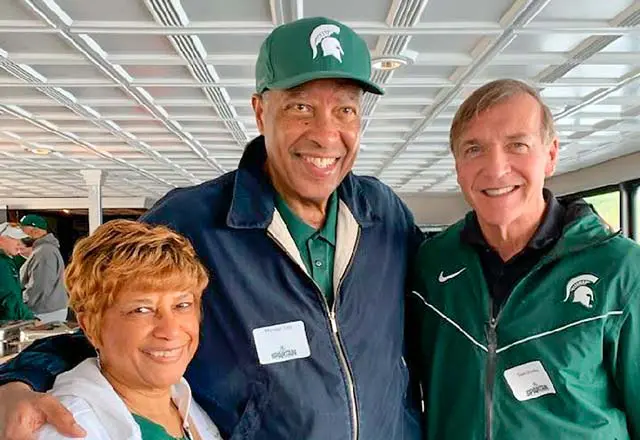
The Tate Family
With our giving, we wanted to invest in programs that serve a broad range of students, both athletically and academically. Our interest is really to support as many students as possible.
Whether academics or athletics, east vs. west, or agreeing on when the sun rises, for Dr. Michael and Winifred Tate striking a balance has defined their life story and their philanthropic desires.
Whether academics or athletics, east vs. west, or agreeing on when the sun rises, for Dr. Michael and Winifred Tate striking a balance has defined their life story and their philanthropic desires. “We met in the fall of 1968, in a natural science class. We got into an argument about what time the sun rose. We weren't aware that, after a while, we were the only two people left in this discussion. Several years later, I was walking across campus, and I saw our professor from that class. He stopped me and asked, “So, did you marry that guy?” Winifred recalls. “So that's where we started, natural science, MSU. It's referred to as 'the great family lore' in our household.”
Both originally from Detroit, Winifred (from the east side) and Michael (from the west side) celebrated their 50th wedding anniversary in September. Back in the '50s and '60s, the two sides of Detroit didn't usually come together, but they found harmony at Michigan State.
Michael: “Michigan State University has given so much to me, yet started in a simple way. In my high school biology class, our teacher (newly graduated from MSU) took us on a field trip to Michigan State to see this brand-new facility and learn what Food Science and Human Nutrition was all about. That is when I got a hands-on, first view of Michigan State. That's when, for me, the “Spirit of Sparty' started.
“Michigan State shaped who I am today — what career I had, what kind of husband and father I am, and, in large part, where my values come from. Michigan State gave me my first professional job and created opportunities for me to travel all across the world. I spent 27 years at Michigan State in various positions.” Michael J. Tate, Ph.D., began his career in 1972 as a 4-H agent in Berrien County, Michigan. In 1976, he became a statewide 4-H program leader with Michigan 4-H before becoming Michigan's first African American state 4-H director in 1983. He would serve in this role, as well as the assistant director for MSU Extension, until 1993.
Winifred added, “I was actually a volunteer tutor for the athletic department for my first two years at Michigan State. It was kind of funny, I'm a very small person and I'd find myself sitting in a room with some 6'6”, 300lb football player! Students would come that had all the physical prowess, but not always the academic knowledge. Sometimes you had to go back to the basics to get them through. It was very interesting. And to see how it has become something organized and a place to study, for me, it is very near and dear to my heart.”
To show their appreciation in a meaningful way to them, the Tates established the Dr. Michael J. Tate and Winifred Ann Tate Family Endowment — a program endowment providing expendable funds for Student-Athlete Support Services (SASS).
Michael: “We're both 72 years old. There are a lot of alums sitting right now at 72 and saying, 'Okay, now where are we going to put our money? We looked at ourselves and said if we don't do it now, we won't ever do it. It's time to show our appreciation, but also our passion.
“With our giving, we wanted to invest in programs that serve a broad range of students both athletically and academically. Academically, we support the library — the hub for all students. By the same token, Student-Athlete Support Services is the academic place for 700-800 student-athletes at Michigan State. We were very happy when that facility was built, and that it came from a Detroiter, Clara Bell Smith.
“The endowment was just our way of wanting to be committed in perpetuity. It is a family endowment, so over time, our children and grandchildren may give to this endowment as well. Our interest is to support the academic work for as many studentathletes as possible regardless of what sport they're in. As you know, the majority of our student-athletes will go on to other careers, so academic services are very, very important. We hope to encourage good academic performance, graduation with at least a bachelor's degree, and then perhaps moving onto a graduate degree at some point in time.
“We think it's important for a university, for an athletic department, to have the kind of support from those who feel passionate about their alma mater — and we're passionate about MSU.”